Showing posts with label Carmel Grain Elevator. Show all posts
Showing posts with label Carmel Grain Elevator. Show all posts
Friday, April 20, 2012
Thursday, April 19, 2012


Monday, April 9, 2012
Marsh Davis, President of Indiana Landmarks Checks In, Again
Today, April 9, 2012 Marsh Davis, President of Indiana Landmarks made this statement about Carmel's historic grain elevator:
"Carmel, as a promoter of arts, is missing an opportunity to use the elevator as a very large art exhibit. It could be interpreted for what it is and how grain elevators affected the course of modern architecture. Not just architecture, but commerce, transportation, agriculture, building materials. It represents major progress and historic changes in all of these forces, and they are embedded in this structure. Interpreting it as such would be innovative and authentic. Assessing the feasibility of that is what Indiana Landmarks was interested in probing and why we offered to study it."

"Carmel, as a promoter of arts, is missing an opportunity to use the elevator as a very large art exhibit. It could be interpreted for what it is and how grain elevators affected the course of modern architecture. Not just architecture, but commerce, transportation, agriculture, building materials. It represents major progress and historic changes in all of these forces, and they are embedded in this structure. Interpreting it as such would be innovative and authentic. Assessing the feasibility of that is what Indiana Landmarks was interested in probing and why we offered to study it."


Thursday, March 29, 2012
Marsh Davis, President of Indiana Landmarks Checks In
From Marsh Davis, President of Indiana Landmarks, March 29, 2012:
"Carmel should keep the elevator as a piece of sculpture and interpret it as such."

"Carmel should keep the elevator as a piece of sculpture and interpret it as such."

Friday, March 23, 2012
The Final Chapter - The Carmel Grain Elevator

The week of the March the 24th was quite a week.
At Monday's City Council Meeting I made a presentation to the City Council and the Mayor. At the end of the presentation I was able to make public an offer that the President of Indiana Landmarks Marsh Davis had made to Mayor Brainard. Indiana Landmarks would provide a grant to study the feasibility of preserving or reuse of Carmel's grain elevator.
On Wednesday NUVO published an article written by art critic and feature writer Dan Grossman.
On Wednesday a gracious Carmel Redevelopment Commission (CRC), at the request of Commissioner Dave Bowers, suspended their scheduled agenda so I could address the CRC. Video of this presentation and discussion can can be seen at this link starting at 37:27.
On Thursday after I had, via email, submitted my presentation to Carmel City Councilors and CRC Commissioners I received an extensive response from the President of the CRC, Mr. Bill Hammer. This email letter contains information regarding the feasibility of the reuse of the grain elevator.
Mr. Hammer's letter is quite thoughtful and well written. Being a civil engineering graduate and having some experience in structural matters (while with the Indiana Department of Transportation I did design bridges and inspected and analyzed existing bridges for their structural and hydraulic capacity; the biggest bridge that I inspected was the old reinforced concrete U.S. 40 bridge over White River in downtown Indianapolis) I recognize the merit, plausibility and concern expressed in Mr. Hammer's commentary.
The studies that were done in the past that are referenced by Mayor Brainard in a recent news article, by Mr. Olds in the CRC meeting and Mr. Hammer in his fine letter along with other materials such as photographs, written histories, oral histories, etc. need to be gathered into an archive for the Carmel grain elevator. This way future generations can see and learn about the history of Carmel's grain elevator and its architecture as well as understand the reasons it was razed. I am willing to provide photographs that I have made for this archive and would also appreciate the opportunity to have on permanent display a selection of my photographs and writings on the grain elevator. I will be contacting the CRC to see what the possibilities are.
Needless to say I wish the end result as to the fate of Carmel's grain elevator would have been different. Certainly I would have liked to see the Mayor take Marsh Davis' (President of Indiana Landmarks) offer of a grant to examine all possibilities of preservation. It would have been wonderful for the grain elevator to remain as monumental piece of sculpture so that others would have had the opportunity to be inspired and interpret it in the same way many of the world's greatest architects and artists have interpreted America's grain elevators. But it is not to be.
I need to thank a great many people that have been on this ride that have supported me, provided information and done a lot of work throughout this effort.
And thanks to those that were willing to step up to the plate and, even at the last minute, have a dialog about Carmel's grain elevator.
So here goes: Thanks to my wife Julie, Mike and Karen Stroup, Kiel Kinnaman, Marsh Davis, Vess von Ruhtenberg, Natalie Ingle, SoHo Cafe, the Carmel City Council and the Carmel Redevelopment Commission, especially Commissioner Bowers and President Hammer. And a special thanks to everybody that supported this effort via Facebook, Twitter, telephone calls, emails and conversations.
I very truly hope that this issue has brought to light the importance of Carmel's government enlisting the thoughts and ideas of its interested and talented citizens into its plans to make Carmel a better city and to make Carmel a city in which its citizens have ownership and pride.
Monday, March 12, 2012
The Carmel Grain Elevator - An Essay
The Carmel Grain Elevator
(Progress, Ingenuity, Innovation, Economic Development, Architecture and the Arts)
Ron Kern
March 12, 2012
Carmel’s grain elevator - so what’s the big deal? It is just an eyesore that needs to go away so we can have progress, right? Progress, ingenuity, innovation, economic development, architecture, the arts, these are thing that, in Carmel, we pride ourselves in. In fact, we’ve centered our future and invested upon these ideals.
The big deal is that Carmel’s historic grain elevator embodies all of these very same ideals that we are using to move Carmel into and through this century.
The grain elevator is Carmel’s greatest remaining historic asset. It reminds us of a time when Carmel was a small farming community, its own community, not a suburb of a metropolitan area. The grain elevator was a economic development tool, an innovation that made it much more efficient to process farmer’s harvests to the market and thereby giving Carmel life. While it may seem insignificant to us today, this towering slab of concrete via the railroad system, helped feed our communities and provided jobs. Without the grain elevator, Carmel would have been a very different place. Would it even have continued to exist? With it, Carmel had progress.
Our expanding roadway system eventually led to the railways becoming less efficient and definitely less convenient for transporting grain. This drove many of the grain elevators out of business as the new system yielded a more consolidated approach to gathering the harvest. Corporate farming was the last nail in the coffin for many grain elevator operations. Scores of small towns were hurt greatly when the grain elevators eventually shut down. I examined this phenomenon in a small town Indiana photographic project in the mid-1990s.
The grain elevator itself is a pinnacle of American ingenuity and achievement. It was designed and constructed with regard to need and function. No formal school of architecture taught the Midwest American engineer how to design such a structure. Grain elevators became a beacon of a coming age. They inspired Modernist architects and artists into a design awakening of unadorned classicism. To name a few, America’s grain elevators inspired architects such as Sullivan, Richardson and Wright here in the United States and Behrens, Gropius and Mies van der Rohe of Germany, Elial Saarinen of Finland and Le Corbusier of France.
In fact Le Corbusier, one of the world’s great architects and writers, in his seminal book “Towards a New Architecture,” grain elevators are featured prominently in the section of the book, Three Reminders to Architects, Part 1 Mass. Please bear with me while I quote the last portion of the this section where Le Corbusier summarizes the significance of the design of the grain elevator’s inspiration to architecture:
“Not in pursuit of an architectural idea, but simply guided by the results of calculation and the conception of a LIVING ORGANISM, the ENGINEERS of to-day make use of the primary elements and, by co-ordinating them in accordance with the rules, provoke in us architectural emotions and thus make the work of man ring in unison with universal order.
Thus we have the American grain elevators and factories, the magnificent FIRST-FRUITS of the new age. THE AMERICAN ENGINEERS OVERWHELM WITH THEIR CALCULATION OUR EXPIRING ARCHITECTURE.
It is obvious from Le Corbusier’s writing that the grain elevator was a major inspiration for modern architecture’s awakening.
A great many modern artists have been inspired by grain elevators. One example is Charles Demuth’s masterpiece, “My Egypt.” Demuth considered grain elevators a modern equivalent to the Pyramids.
Many photographers have been inspired by grain elevators. Renowned photographer Frank Gohlke has made photographing Midwest and Great Plains grain elevators a significant part of his career. This work resulted in exhibitions at major museums; for example the 1978 exhibition “Grain Elevators” was hosted at The Museum of Modern Art and traveled across the United States through 1980. In 1992 The Johns Hopkins University Press published the acclaimed book of Gohlke’s grain elevator photographs, “Measures of Emptiness: Grain Elevators in the American Landscape (Creating the North American Landscape.”
Carmel’s grain elevator is truly an excellent example of that which inspired the modernists. Its somewhat large scale is well proportioned and its form varies from side to side. Having such a wonderful example in such a small town speaks to the fact that Carmel was indeed an important location within the agricultural community.
The grain elevator has been an inspiration for my photography. I have photographed it for many years. This past January and February a recent photograph of the grain elevator was an anchor image for an exhibition of my year long photography project entitled, “Truth From Perceptions.”
Carmel desires to be and is working toward being an art-centric community. It is forging its own identity and is becoming it’s own city rather than being a suburban bedroom community. So, in some ways Carmel has come around full circle since its early days when Carmel was its own community among the farm fields, along the railroad line where the grain elevator was a central part of its economy and gave the town life.
As I mentioned previously, Carmel’s historic grain elevator embodies the exact same ideals that Carmel has invested in to make our community great now and in the future. It indeed is an excellent example of modern American architecture.
Demolishing our grain elevator will be a major blow to Carmel’s image of being a community that is serious about and invested in the arts. Demolishing such an important, significant structure steeped in history with regard to our community and the arts, I fear, will validate the view that Carmel is not to be taken seriously within the arts community.
I see the reuse of our grain elevator as an opportunity for our community. One idea is to incorporate an observation deck into the reuse. Imagine being able to see the contemporary success and progress of our city in the area of Carmel’s original town from a structure that harkens back to, and reminds us of, our history.
Our grain elevator is a huge opportunity to get public buy-in for historic preservation. Recently the Carmel City Council passed, and the Mayor signed into law, an historic preservation ordinance. There is not a more obvious place to start this process than at our historic grain elevator. Community pride in Carmel’s history would result in an engaged community that appreciates and learns about its roots from which a part of our identity is generated for both newcomers and old-timers alike.
Utilizing our grain elevator as a community gathering site would appeal to a diverse demographic which is imperative for the health of our community. Day to day it would be a non-consumer oriented inclusive gathering place. It is in an excellent location with the Arts and Design District and is easily seen from quite a distance. Many different functions could be held at the grain elevator site, music performances, arts festivals, community meetings, etc. For example - where is the high school jazz group playing this Thursday evening? At the grain elevator - no further directions would be required. It is a perfect place for the Carmel Clay Historical Society to hold events such as arts programs for kids and adults alike. For festivals streets would not have to be blocked off and parking would be plentiful. To get to a festival or function just a short walk to and on the Monon Trail would be all it would take.
I have lived in the Carmel area for approximately fifty years. Yes, I guess I could be considered to be an old-timer. I went to Carmel-Clay schools from kindergarten through graduation in 1976. My wife Julie, who grew up not too far away in Nora, and I make our home here. We love the arts and are both actively making art. So, I have deep roots here and appreciate Carmel today as well as its history.
Sincerely, I am requesting that the Carmel Redevelopment Commission not demolish our grain elevator. And, I am requesting that the Carmel City Council do all it can in its power to stop the destruction of our grain elevator. It is an authentic historical asset that cannot possibly be replaced by anything new.
Thank you to Vess von Ruhtenberg for his inspiration, guidance and information.
(Progress, Ingenuity, Innovation, Economic Development, Architecture and the Arts)
Ron Kern
March 12, 2012
Carmel’s grain elevator - so what’s the big deal? It is just an eyesore that needs to go away so we can have progress, right? Progress, ingenuity, innovation, economic development, architecture, the arts, these are thing that, in Carmel, we pride ourselves in. In fact, we’ve centered our future and invested upon these ideals.
The big deal is that Carmel’s historic grain elevator embodies all of these very same ideals that we are using to move Carmel into and through this century.
The grain elevator is Carmel’s greatest remaining historic asset. It reminds us of a time when Carmel was a small farming community, its own community, not a suburb of a metropolitan area. The grain elevator was a economic development tool, an innovation that made it much more efficient to process farmer’s harvests to the market and thereby giving Carmel life. While it may seem insignificant to us today, this towering slab of concrete via the railroad system, helped feed our communities and provided jobs. Without the grain elevator, Carmel would have been a very different place. Would it even have continued to exist? With it, Carmel had progress.
Our expanding roadway system eventually led to the railways becoming less efficient and definitely less convenient for transporting grain. This drove many of the grain elevators out of business as the new system yielded a more consolidated approach to gathering the harvest. Corporate farming was the last nail in the coffin for many grain elevator operations. Scores of small towns were hurt greatly when the grain elevators eventually shut down. I examined this phenomenon in a small town Indiana photographic project in the mid-1990s.
The grain elevator itself is a pinnacle of American ingenuity and achievement. It was designed and constructed with regard to need and function. No formal school of architecture taught the Midwest American engineer how to design such a structure. Grain elevators became a beacon of a coming age. They inspired Modernist architects and artists into a design awakening of unadorned classicism. To name a few, America’s grain elevators inspired architects such as Sullivan, Richardson and Wright here in the United States and Behrens, Gropius and Mies van der Rohe of Germany, Elial Saarinen of Finland and Le Corbusier of France.
In fact Le Corbusier, one of the world’s great architects and writers, in his seminal book “Towards a New Architecture,” grain elevators are featured prominently in the section of the book, Three Reminders to Architects, Part 1 Mass. Please bear with me while I quote the last portion of the this section where Le Corbusier summarizes the significance of the design of the grain elevator’s inspiration to architecture:
“Not in pursuit of an architectural idea, but simply guided by the results of calculation and the conception of a LIVING ORGANISM, the ENGINEERS of to-day make use of the primary elements and, by co-ordinating them in accordance with the rules, provoke in us architectural emotions and thus make the work of man ring in unison with universal order.
Thus we have the American grain elevators and factories, the magnificent FIRST-FRUITS of the new age. THE AMERICAN ENGINEERS OVERWHELM WITH THEIR CALCULATION OUR EXPIRING ARCHITECTURE.
It is obvious from Le Corbusier’s writing that the grain elevator was a major inspiration for modern architecture’s awakening.
A great many modern artists have been inspired by grain elevators. One example is Charles Demuth’s masterpiece, “My Egypt.” Demuth considered grain elevators a modern equivalent to the Pyramids.
Many photographers have been inspired by grain elevators. Renowned photographer Frank Gohlke has made photographing Midwest and Great Plains grain elevators a significant part of his career. This work resulted in exhibitions at major museums; for example the 1978 exhibition “Grain Elevators” was hosted at The Museum of Modern Art and traveled across the United States through 1980. In 1992 The Johns Hopkins University Press published the acclaimed book of Gohlke’s grain elevator photographs, “Measures of Emptiness: Grain Elevators in the American Landscape (Creating the North American Landscape.”
Carmel’s grain elevator is truly an excellent example of that which inspired the modernists. Its somewhat large scale is well proportioned and its form varies from side to side. Having such a wonderful example in such a small town speaks to the fact that Carmel was indeed an important location within the agricultural community.
The grain elevator has been an inspiration for my photography. I have photographed it for many years. This past January and February a recent photograph of the grain elevator was an anchor image for an exhibition of my year long photography project entitled, “Truth From Perceptions.”
Carmel desires to be and is working toward being an art-centric community. It is forging its own identity and is becoming it’s own city rather than being a suburban bedroom community. So, in some ways Carmel has come around full circle since its early days when Carmel was its own community among the farm fields, along the railroad line where the grain elevator was a central part of its economy and gave the town life.
As I mentioned previously, Carmel’s historic grain elevator embodies the exact same ideals that Carmel has invested in to make our community great now and in the future. It indeed is an excellent example of modern American architecture.
Demolishing our grain elevator will be a major blow to Carmel’s image of being a community that is serious about and invested in the arts. Demolishing such an important, significant structure steeped in history with regard to our community and the arts, I fear, will validate the view that Carmel is not to be taken seriously within the arts community.
I see the reuse of our grain elevator as an opportunity for our community. One idea is to incorporate an observation deck into the reuse. Imagine being able to see the contemporary success and progress of our city in the area of Carmel’s original town from a structure that harkens back to, and reminds us of, our history.
Our grain elevator is a huge opportunity to get public buy-in for historic preservation. Recently the Carmel City Council passed, and the Mayor signed into law, an historic preservation ordinance. There is not a more obvious place to start this process than at our historic grain elevator. Community pride in Carmel’s history would result in an engaged community that appreciates and learns about its roots from which a part of our identity is generated for both newcomers and old-timers alike.
Utilizing our grain elevator as a community gathering site would appeal to a diverse demographic which is imperative for the health of our community. Day to day it would be a non-consumer oriented inclusive gathering place. It is in an excellent location with the Arts and Design District and is easily seen from quite a distance. Many different functions could be held at the grain elevator site, music performances, arts festivals, community meetings, etc. For example - where is the high school jazz group playing this Thursday evening? At the grain elevator - no further directions would be required. It is a perfect place for the Carmel Clay Historical Society to hold events such as arts programs for kids and adults alike. For festivals streets would not have to be blocked off and parking would be plentiful. To get to a festival or function just a short walk to and on the Monon Trail would be all it would take.
I have lived in the Carmel area for approximately fifty years. Yes, I guess I could be considered to be an old-timer. I went to Carmel-Clay schools from kindergarten through graduation in 1976. My wife Julie, who grew up not too far away in Nora, and I make our home here. We love the arts and are both actively making art. So, I have deep roots here and appreciate Carmel today as well as its history.
Sincerely, I am requesting that the Carmel Redevelopment Commission not demolish our grain elevator. And, I am requesting that the Carmel City Council do all it can in its power to stop the destruction of our grain elevator. It is an authentic historical asset that cannot possibly be replaced by anything new.
Thank you to Vess von Ruhtenberg for his inspiration, guidance and information.
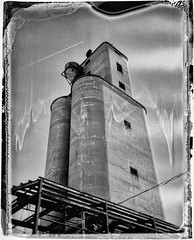 | |||||
| Carmel Grain Elevator 1, Polaroid Process |
Tuesday, January 24, 2012


Saturday, January 7, 2012
The Imminent Demolition of the Carmel Grain Elevator
 |
| Contrail, Power Line and AbandonedGrain Elevator, Carmel, IN |
"Thus we have the American grain elevators and factories, the magnificent FIRST-FRUITS of the new age." - Le Corbusier, Towards a New Architecture, 1927.
A photograph of Carmel's landmark historical grain elevator structure is one of the two anchor images of my project, Truth From Perceptions. Currently it is in the 2 Photographers Works In Progress Exhibition at Midland Arts and Antiques Market in downtown Indianapolis.
I had also written about the area in a post from this blog dated August 9, 2011. These photographs were included in that post:

Imagine my surprise when I read on Twitter this past Saturday that it is a done deal that the City of Carmel is going to demolish the grain elevator. Apparently, technically, it is the Carmel Redevelopment Commission (CRC) that is going to do the deed. According to City documents the CRC requested the Board of Public Works, which consists of the Mayor and two appointees, to write a resolution to demolish the structure. Apparently that three person Board of Public Works has the power to act on the behalf of the CRC and indeed they did.
From what I've been told from a very reliable source the CRC can do whatever it wants to in this area by virtue of zoning law. The CRC is an appointed government entity that does not answer to Carmel's City Council and therefore the citizens of Carmel. And today I found out that they actually are able to encumber the City of Carmel with debt without getting approval from the City Council, ie the Citizens of Carmel. That was a shocker.
Apparently the Mayor and the CRC have a plan to build an additional water tower straddling the Monon Trail that has fountains or some such thing and rather than consider integrating the grain elevator into the plan they are going to demolish it, again, with no public input. There are instances where these structures have been reused in various ways. Being a part of the Arts and Design District I would hope that rather than tear down one of the last historical structures connecting Carmel to its past that the CRC would come up with a more creative solution. Maybe even ask the public and artists and architects for some ideas. But recent history shows that Carmel's government likes shiny new things. Problem is that, not much later, those shiny new things become dull older things that seemed like a good idea at the time.
It was extremely disappointing to see in an Indianapolis Star article Carmel Clay Historical Society's (CCHS) board member Fred Swift easily dismiss this structure as having no historical significance. Yet in the next breath he makes the case for the structure when he acknowledges that the structure has been a part of Carmel's landscape for ninety years and was one of Carmel's largest employers before Carmel was a "big suburb." Update 2-25-2012 - From an IBJ article it is now known that the CCHS received a $31,000 grant from the 4CDC which is an organization that works as a shadow government entity that disperses Carmel public money with no public input nor oversight. So it is no surprise that the CCHS has no interest in preserving the grain elevator.
Apparently now that Carmel is a suburb we no longer have any use for our agricultural past. I expect more than this from an organization that is supposed to be protecting our history outside of local politics.
I find it ironic that the CCHS is housed in, what I'm certain Mr. Swift considers historically significant structures, railroad depot buildings that were repurposed to suit CCHS' needs and are in the shadow of the grain elevator.
Even more ironic is this news story from Current in Carmel; the first two paragraphs are here:
The City Council Monday night approved an ordinance authorizing historic preservation and the creation of a historic preservation commission.
The ordinance, which passed with a 6-1 vote, was proposed to “provide a means to promote the cultural, economic, and general welfare of the public through the preservation and protection of structures and areas of historic and cultural interest within the City” and to “maintain established neighborhoods in danger of having their distinctiveness destroyed,” among other stated purposes.
Zack Myers of Fox 59 news interviewed me for their story on the demolition of the grain elevator.
I encourage you to read an article about all of this written by Jonathon Haag that can be found on his blog, Innovate Carmel.
Here is a recent letter to the editor of the Indianapolis Star by Jane Oakes:
Maybe we can progress without
tearing down grain elevator
6:41 PM, Jan. 05, 2012
I hadn’t thought about the Carmel Grain Elevator in years, but all of a sudden the story on Wednesday, Jan. 4 (“Eyesore or landmark, elevator’s coming down”) brought back a virtual flood of memories. When I moved to Carmel as a child, there were 771 people living there, as attested by a sign at the south edge of town.
At the Carmel school, all in one brick building at the east end of Main Street, I was in the same class with both Fosters and Kendalls, the families that owned the grain elevator. The Monon Railroad was a large part of the community from the proximity to the grain company to the hook by the large door that snagged mailbags each day. Putting a penny on the tracks was an exciting pastime; I’ll bet if I looked carefully enough I might still have a very thin, flat, smashed penny. Progress does not always mean removing the past. Sometimes it means honoring it through visible memories.
Jane S. Oaks
Indianapolis
A fellow grad from Carmel High 1976 had this to say about the grain elevator:
The Carmel Grain Elevator should be preserved as a historical landmark... Even as the town moves forward, and the landscape through the years has changed, it should always leave reminders of what once was.
Mike Sapp
Also there is a discussion on Carmel City Councilor's Rick Sharp's Facebook page.
Subscribe to:
Posts (Atom)